
Introduction
Each year, more than 20,000 adolescents in the US are emancipated from foster care as they enter adulthood, a transitional period associated with heightened vulnerability to adverse health, economic, and educational outcomes.1 Estimates from advocacy and research organizations find that about 25% of former foster youth experience housing instability within 4 years of aging out of care.2 These young adults face significant challenges in education attainment, with 8% to 12% completing postsecondary degrees, compared with much higher rates among their non-foster care peers.3
Foster care youth struggle to develop meaningful social connections, establish employment, access health care, and find it difficult to avoid involvement in criminal activity. The estimation of 50% being unemployed by age 24 is from older longitudinal research and there is limited recent data that is equally extensive. However, more recent studies confirm that employment outcomes for foster youth still lag those of their peers.4,5 Estimates from 2018 demonstrate that 56% of former foster youth experienced unemployment by age 21, with similar estimates in 2021 and 2022.6
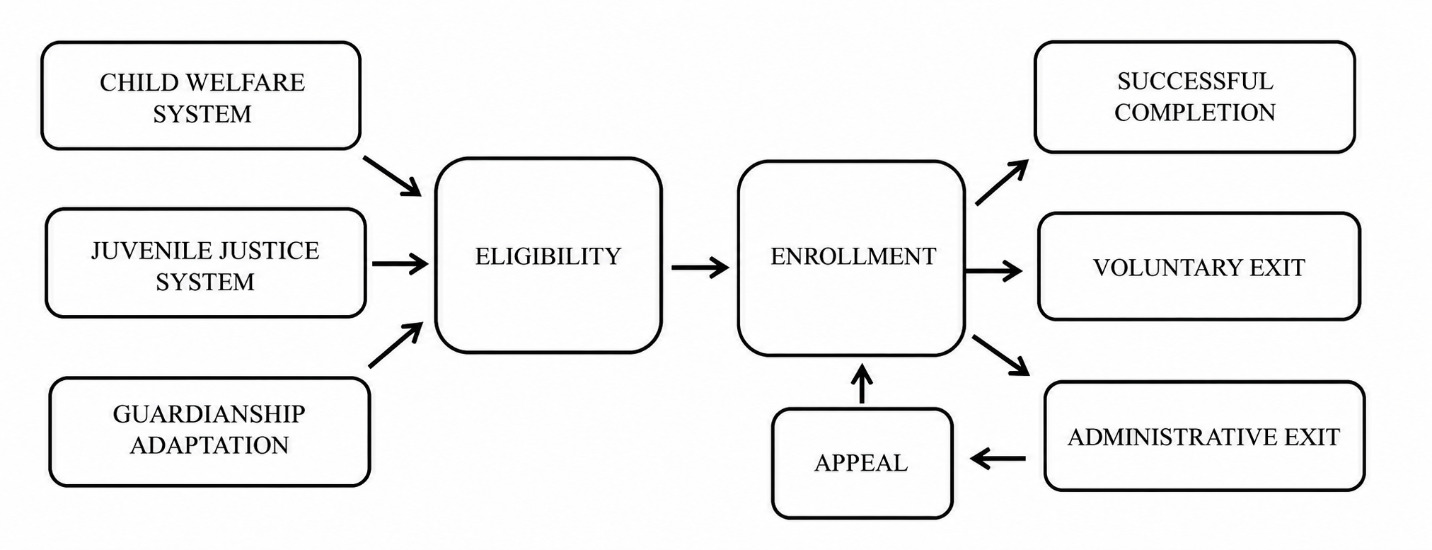
In response to this crisis, Congress passed the Fostering Connections to Success and Increasing Adoptions Act in 2008,7 permitting states to extend foster care services to age 21 without federal approval. Following enactment of this legislation, Nebraska established the Bridge to Independence (B2i) program in 2013 (Figure 1).
Since the program’s inception, over 1498 youth have participated in B2i.8 Each year in Nebraska, between 120 and 300 individuals in foster care turn 19. In 2023, 135 Nebraskans exited foster care to emancipation,9 While the B2i program has resulted in improved support for individuals as they transition out of foster care, current aims include connecting individuals with B2i resources earlier, expanding eligibility to Juvenile Justice (JJ) youth, and including Deferred Action for Childhood Arrivals (DACA) and Special Immigrant Juvenile Status (SIJS) youth participation.10 The purpose of this article is to present Nebraska’s foster care transition system as a model of promising practices that may inform efforts in other states to reduce housing instability and improve developmental outcomes among emancipated adolescents. This article will discuss the specific elements of the B2i program and the current evidence that demonstrates the program’s effectiveness in supporting the transition from foster care to independent adult living. The objective is to encourage other states to extend services for young adults exiting the foster care system.
What Does B2i Offer?
B2i is a voluntary program, as it strives to recognize the autonomy of participants. To enroll in Nebraska’s program, a young adult must be between 19 and 21 years old. In the case of certain Native American youth, whose term in foster care ends earlier, the minimum age for B2i program participation is 18 years. Young adult participants must have been assessed in juvenile court as having histories of abuse or neglect, involvement in juvenile offenses, or placement in guardianship or adoption after age 16 through the Department of Health and Human Services (DHHS). At the time of the individual’s 19th birthday, they must be in an eligible out-of-home placement or discharged to independent living. Participants must also be Nebraska residents and, under current law, be either US citizens or have an immigration status considered “lawfully present”. B2i participants sign a Voluntary Services and Support Agreement with DHHS, which establishes case management and financial support. To remain eligible, participants must live in an approved housing arrangement, such as supervised independent living, a group home, dormitory, or other DHHS-approved setting; if a B2i program participant moves, they must send a notification within 10 business days. Additionally, they must meet the work or education requirements: school enrollment, working a minimum of 80 hours a month, engaged in job skills training, or medically exempt from these activities. For individuals who are not deemed medically exempt, a lapse of no greater than 30 days may be present before becoming ineligible. Participants must also maintain regular monthly contact with their Independence Coordinator. Incarceration, moving out of Nebraska, or failing to meet requirements may result in termination from the program.8
Participation in the B2i program provides young adults with comprehensive support designed to make the transition to adulthood smoother. Central to the program is a monthly maintenance stipend of $944 (as of 2023), which helps cover housing and living expenses. The stipend aims to provide financial stability while the young adult works on developing skills necessary for a successful transition to independent adult living. Young adults in the B2i program also receive medical and dental coverage through Medicaid.
Participants are mandated to report to Independence Coordinators, who provide individualized case management, assist in individualized goal-setting, and ensure that participants have access to vital documents, education, employment, and community resources. Independence Coordinators also help young adults navigate public benefits, build financial literacy, and connect to supportive adult networks.
The B2i program helps participants maintain housing stability by supporting approved living arrangements. B2i also administers legal oversight from the courts to ensure that services remain in the young person’s best interest and that they receive comprehensive support.10
Beyond providing community-based services, B2i helps foster long-term personal and professional growth. Through leadership opportunities, career exploration, and personal development activities, participants can strengthen skills, gain confidence, and build meaningful relationships that extend beyond the program. Together, these benefits provide young adults with the guidance and opportunities they need to enter adulthood with greater security, resilience, and hope for the future.5,7
Nebraska’s B2i program shares key features with extended foster care models in states such as California, New York, and Illinois, which allow eligible young adults to remain in care or receive support through age 21 (Table 1).8,11,12 As with these programs, B2i requires engagement in education, employment, and training, and provides financial assistance and case management to support early adult stability. Nebraska’s use of Independence Coordinators parallels case management structures in other states, emphasizing goal-setting, service coordination, and adult mentorship. Although Nebraska operates on a smaller scale, B2i reflects the same policy logic underlying extended foster care nationally, contributing to a broader movement toward extending foster care support beyond age 18.5,8
Program Impact
Participation in Nebraska’s B2i program is associated with improved outcomes across multiple domains central to early adult stability. A 2019 evaluation found that B2i participants were more likely than peers who exited foster care without extended support to be enrolled in postsecondary education, live in safe and stable housing, meet basic living expenses, accumulate savings, and report having at least one supportive adult.8
Nebraska Foster Care Review Office data indicate that in 2023, 87% of active B2i participants were making progress toward independent living goals, most commonly in transportation, employment, education, financial stability, housing, and health.10,13 These domains reflect key developmental tasks required for successful transitions to adulthood.
Among youth who exited B2i between January and September 2024, approximately half aged out of eligibility (50.4%), while 46.2% exited due to disengagement from required education, employment, or housing.8 These patterns underscore the importance of fostering sustained engagement to prevent premature loss of housing, health care, and adult mentorship during this vulnerable period.
As of September 30, 2024, there were 257 young adults actively enrolled in B2i, with nearly 1500 served since program inception in 2014. Recent legislative expansion to include certain justice-involved youth beginning in 2025 further broadens the program’s reach to populations at heightened risk for housing instability and poor adult outcomes. This expansion aligns Nebraska with national trends toward more inclusive extended foster care policies that recognize overlapping risks among child welfare- and justice-involved youth populations.10–12
A Model Worth Sharing
B2i is a model worth sharing because it demonstrates how a state can thoughtfully extend foster care support beyond the original age of service termination, allowing young adults to be better equipped for the transition into adulthood. Unlike many systems that end services abruptly when youth reach legal adulthood, B2i is youth-driven and designed to respect autonomy, while serving as a safety net. Participants receive monthly financial assistance, health coverage, and personalized case management through Independence Coordinators, ensuring they have both tangible support and trusted adult guidance.
Strengths of B2i include its emphasis on data-driven improvement and youth engagement. The program continuously evaluates outcomes and integrates and responds to youth voices. These practices ensure that B2i evolves alongside the needs of these young adults. Finally, B2i’s outcomes data reveal that youth in the program are more likely to secure stable housing, continue education, build savings, and have supportive adult relationships than peers who age out of foster care without these services. By combining financial stability, health care access, adult mentoring, and system accountability, B2i provides a comprehensive framework that other states can adopt to support foster youth.8
Outcome data suggest that B2i participants experience more favorable transitional outcomes than peers who age out without extended support, particularly with respect to housing stability, continued education, savings behavior, and access to supportive adults.8 These findings are consistent with developmental research emphasizing the importance of extended institutional and relational support during emerging adulthood.5 By combining financial assistance, health care access, and relational continuity, B2i offers a replicable framework for states seeking evidence-informed strategies to support youth transitioning out of foster care.
Limitations
Under current policy, the B2i program excludes many immigrant youths in Nebraska, including those with DACA or SIJS, despite otherwise meeting program criteria. As a result, the present findings may not fully capture the needs and outcomes of this subgroup of youth aging out of foster care. The 2023-2024 B2i Advisory Committee Annual Report estimated that, if such restrictions were modified, an additional 16 to 52 youth who aged out between 2021 and 2023 may have been eligible for participation. Accordingly, the generalizability of these findings to all transition-age youth with foster care involvement may be limited.
Conclusions
The Nebraska B2i program illustrates how an extended foster care model can improve transitional outcomes for youth leaving state custody. Evidence presented here shows B2i’s association with improved housing stability, educational attainment, and engagement with supportive adults compared to peers without such services. Nevertheless, persistent challenges—including limited immigration eligibility and the need for earlier engagement of youth—underscore the importance of continued policy refinement and rigorous evaluation. Future research should explore long-term outcomes, cost-effectiveness, and scalability of B2i’s components to guide broader adoption of evidence-based transitional support programs across jurisdictions.
Plain Language Summary
Each year, thousands of young people leave foster care without stable housing, education, or adult support. Nebraska’s Bridge to Independence (B2i) program extends assistance beyond age 19, offering a monthly stipend, Medicaid coverage, and mentorship through Independence Coordinators. Youth in B2i are more likely than peers who age out without support to secure safe housing, continue school, find employment, and build lasting adult connections. The program has served nearly 1500 young adults since 2014, with recent expansions extending eligibility to youth in the juvenile justice system. B2i provides a strong example of how states can help young people step into adulthood with greater stability and hope. Its comprehensive approach—financial support, health coverage, and personal guidance—offers a model that other states can adapt to improve outcomes for vulnerable youth.
About the Authors
Ayse K. Coskun, MD, MA, Department of Psychiatry, Creighton University, Omaha, Nebraska, USA.
Eunice Yuen, MD, PhD, Yale Child Study Center, Department of Psychiatry, Yale University, New Haven, Connecticut, USA.
Alyssa Thallemer, BSc, School of Medicine, Crighton University, Omaha, Nebraska, USA.
Correspondence to:
Ayse K. Coskun, MA, MD; email: aysecoskun@creighton.edu.
Funding
The authors have reported no funding for this work.
Disclosure
The authors have reported no biomedical financial interests or potential conflicts of interest.
Acknowledgments
ChatGPT was used for editing to improve the quality of the writing for the entire manuscript (excluding references).
Author contributions
Conceptualization: Ayse K Coskun (Lead). Writing – review & editing: Ayse K Coskun (Lead), Eunice Yuen (Supporting), Alyssa Thallemer (Supporting).